






Framing in photography is a composition technique that can bring more interest to a picture. Framing will not only make the subject stand out. It will also integrate it into the environment, or create a story. Framing can also give a better sense of the place to your photos.
We can use man-made frames, natural frames, of both. In this post I’ll go with only man-made, actually architectural framing.
Framing Doors and Doorways
The most obvious man-made frames we see all the time are certainly doors and windows.
Framed by definition, doors can make nice compositions and reveal great scenes interesting to observe and photograph. I made a post earlier on Newfoundland Interesting Doors and Doorways. But I have lots of other framing doors from the places I visited. An example is this photo I took at Fort Maiden, Amhrestburg, Ontario – a National Historic Site of Canada, a living museum.

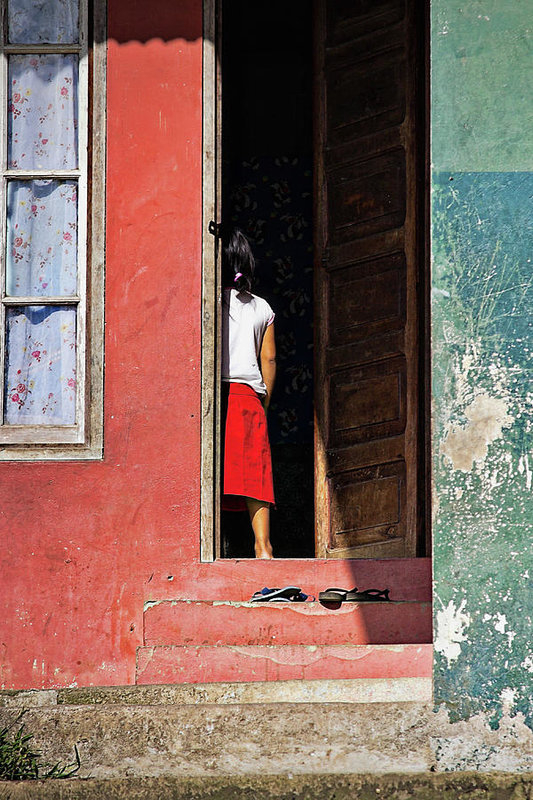
Back in time, I also made a post called “If the doors could talk” about old doors in Casco Viejo, Panama. Talking about Panama, one of my favorite examples on door framing photography is this one below. I called it “Half In”. It’s a young girl entering through an open door of a bungalow at a coffee farm in Boquete, Panama. The light and shadow help emphasize the subject too.
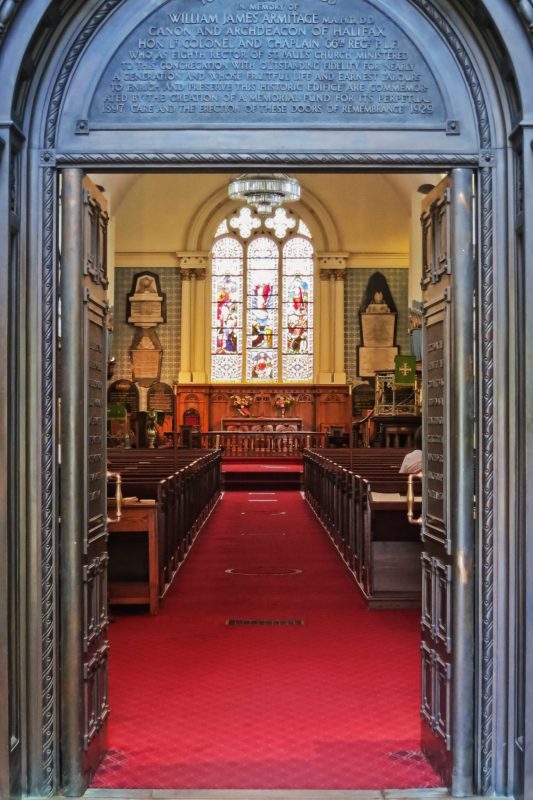
Below I have two more examples of framing doors that I really like. One is from Orange Walk, Belize. The open door to the street lets us see inside of a tailor’s workshop. The other open door reveals part of the interior of the beautiful St.Paul church in Halifax, Nova Scotia. This is actually an example of multiple frames in frames.

Also, I cannot miss this open door – top favorite in one of the SmugMug / Dgrin contests: “Open or Closed”

Entrances and passageways are another examples of framing photography:
Here is a picture I took at Prado Museum in Madrid, Spain. That’s right, what you see is one of the famous Goya paintings. Several elements, including the two roman sculptures, frame the masterpiece and lead the eye to it.

Another example of a nice framing is the entrance to the Louisburg Fortress in Cape Breton, Nova Scotia. It’s another medieval living museum and National Historic Site of Canada.

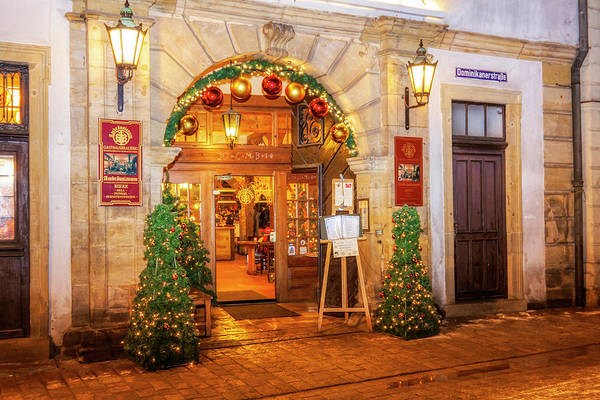
We visited Bamberg in Bavaria at winter holidays time, and you may know that this is a wonderful time to spend in Germany. If you don’t, take my word for it 🙂 The picture shows the entrance of a restaurant brewery at night, framed by Christmas lights:
Framing Arches
I think that arches are particularly interesting for creating framing in photography. We find them mainly in religious establishments, but also in old buildings and towns in Europe and Latin America.
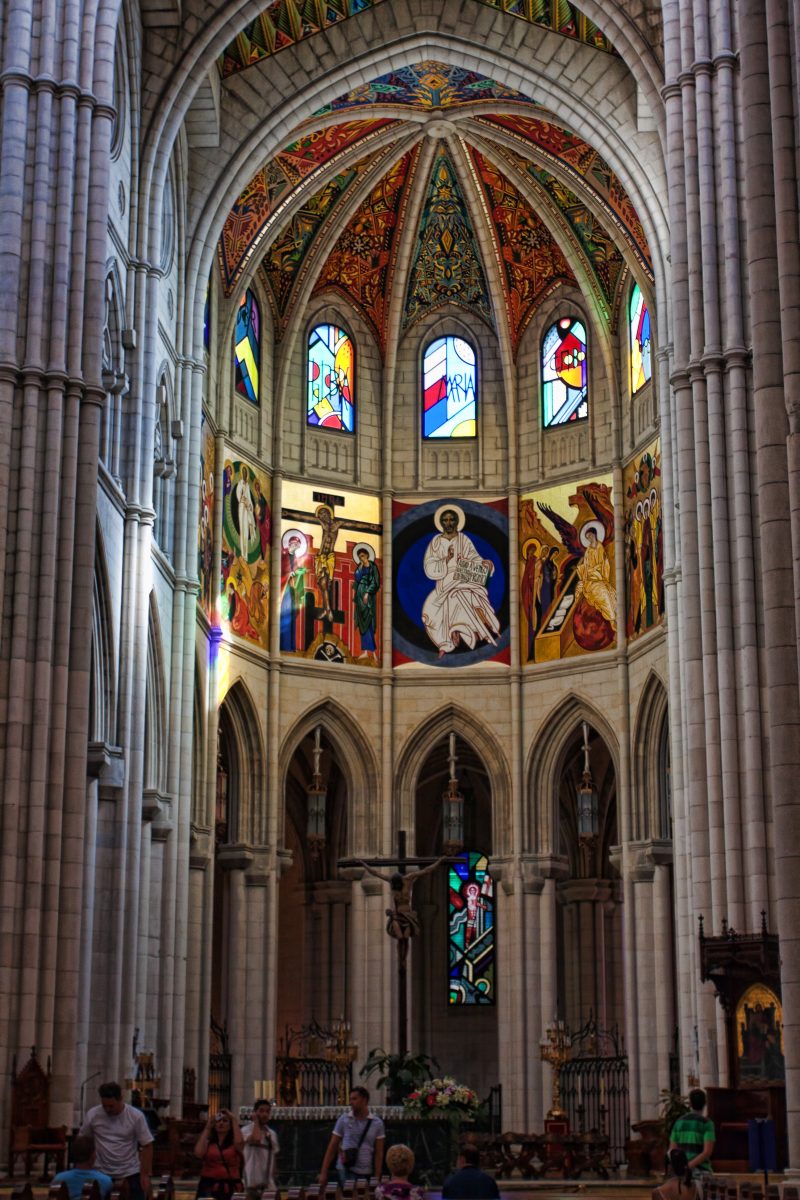
I photographed this beautiful cupola framed by arches, at Almudena Cathedral in Madrid, Spain:

In churches, arches frame elements like stained-glass windows, altars and other artwork. I photographed these below in the same Spanish cathedral in Madrid:

At Saint Maximin la Sainte Baume Monastery in Provence, France, the sunny interior court was framed by columns and arches. I have recreated this image as a color pencil art in the digital media:

The central plaza In Antigua, Guatemala, like in many other cities of Latin America, is bordered with covered sidewalks. Here is how beautiful they are, framing the daily activity of the city:

One more that I really like, is this arch framing the Venetian tower in Las Vegas Venetian Hotel

Bridges are another great opportunity for framing in photography. I’ll make another post on these later..
Inspired by: Lens-Artists Photo Challenge #60– Framing the Shot

Panama Canal Miraflores Locks are the most popular of the three locks of this famous waterway. Miraflores point is also the most accessible by tourists coming from the city, like we did in 2012. What makes it even more popular is the visitors center and the restaurant. – a very busy place 🙂 When a boat arrives, everybody goes out to see it and take photos. The authorities don’t let you go too close to the water, therefore they put a fence along the deck.
I also used every possible and available place and took some shots that I will be always proud to show to my friends.
– “We’ve seen the Panama Canal!“, I tell to anyone inquiring about our travels 🙂

Panama City Is an impressive city combining the modern with the history and tradition. It was actually our first stop in our 3 month journey to Panama.
Panama Canal

Needless to say that Panama Canal is one of the greatest man made marvels of modern history. It literally cuts the American continent in two from the Atlantic to the Pacific for a length of 82 kilometers (about 51 miles). The construction was intended to significantly reduce the time, cost and dangers of water transportation between the two oceans. It was started in 1881 by the French, but they stopped because of technical difficulties at that time. Only in 1904 the United States took over. They finished the project in 1914. Recently (in 2016 ), the Panamanians completed an extension to increase its capacity.
Crossing Panama Canal Miraflores Locks
Although it takes about 8 to 10 hours for a ship to cross the canal, Miraflores is always busy. Cargo boats and cruise ships travel alongside. Smaller embrocations travel at night.
But there is a schedule for the boats that go from the Atlantic to the Pacific and vice-versa, so they don’t conflict.
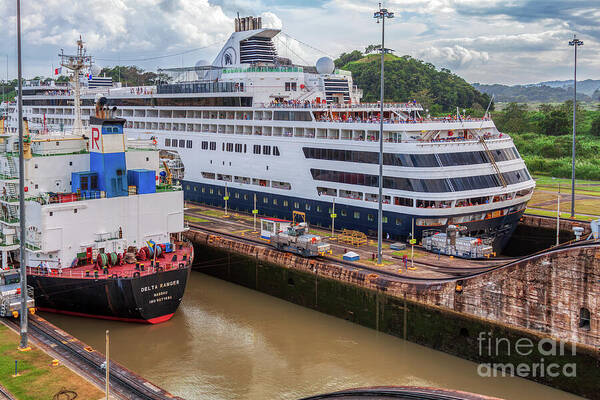
It takes a lot of dexterity to maneuver a boat through the narrow canal and locks. A captain designated by the Panama Canal Authority has to come on board to guide the ship. I’m not sure what the crew does while going through the locks, but they seemed to me quite relaxed 🙂

Because of the high tide in this area, Miraflores also has the tallest locks.The difference in water level between locks is of about 17 meters (54 feet), and the vessels make it in two stages.

What’s great, is that here at Miraflores you can watch the whole process of the crossing operation.
As they enter the canal, the boats are assisted by special leading locomotives. They are secured with ropes tied to the vessels. This is to ensure a smooth passage without accidents.

Yes, I liked this red cargo boat crossing the canal – it’s quite photogenic 🙂

If you are interested, I uploaded some of these photos to my Fine Art America gallery, and they are available as high quality art prints for wall, home decor and more.
Birds Nests and the spring season have two main things in common: 1. They happen at the same time, 2. They fill your heart with love and hopes of a new life. The difference is that a nest is just a glimpse into what spring is all about…
In Europe, it’s quite common to see birds and birds nests in urban areas at springtime, and I find this beautiful.
Portugal
One year, we happened to be in Faro, Portugal for the Easter time, where we’ve seen a lot of birds nests (mainly of storks) on buildings roofs. You really had to look overhead to see them. That was not an inconvenience, but actually, quite the opposite. Along with the storks we could also see some beautiful architectural details, which I always like to admire and photograph during our travels. This one is my favorite of the series. It’s a stork that built her nest on top of a church bell tower – I thought this scene was a powerful symbol for that time of the year and holiday.
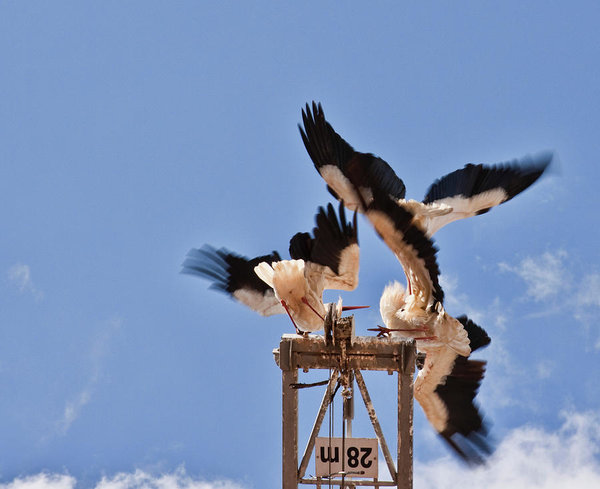
Further on, while visiting Estoi in Portugal I noticed these storks fighting for the nest place on top of a 28 meters (92 feet) high crane. Wow!
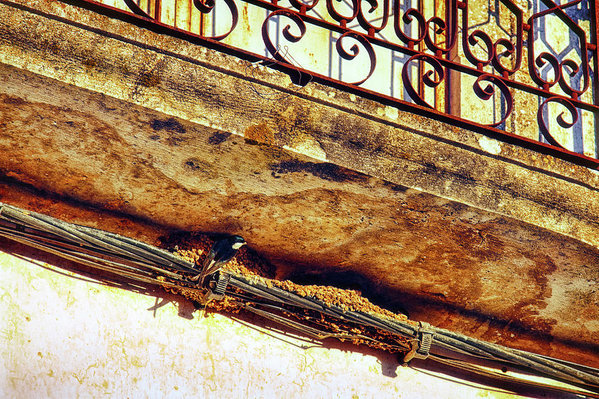
Also in Alte, Portugal, this cute little swallow just landed in front of her nest. In fact, there were several swallow nests under that old weathered balcony, with rusted rails. Lucky them that the thick wiring lines underneath gave support to their construction. I thought it was an interesting juxtaposition and of course, I got the shot.
Germany
Another time, while in Germany by Lake Constance I photographed this male water bird carrying a big branch to his nest.
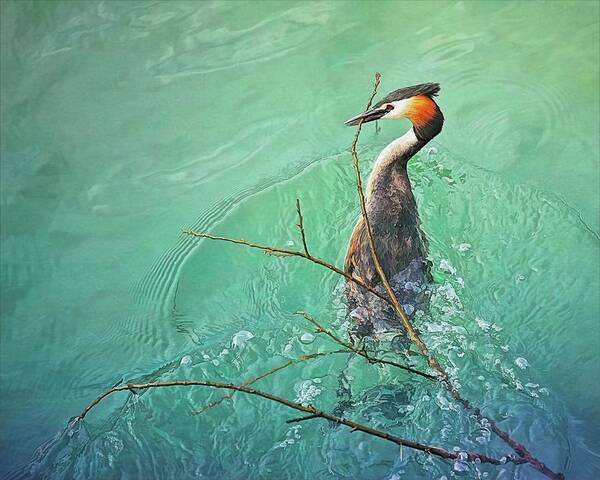
I know it was a male because the female was already in place keeping the eggs warm. (Sorry, but I don’t know the name of these birds). It is sad to see the conditions these birds are forced to live in. Actually, their whole story was tragic. The nest, was flooded by a wave produced by a speed boat and they lost everything 🙁
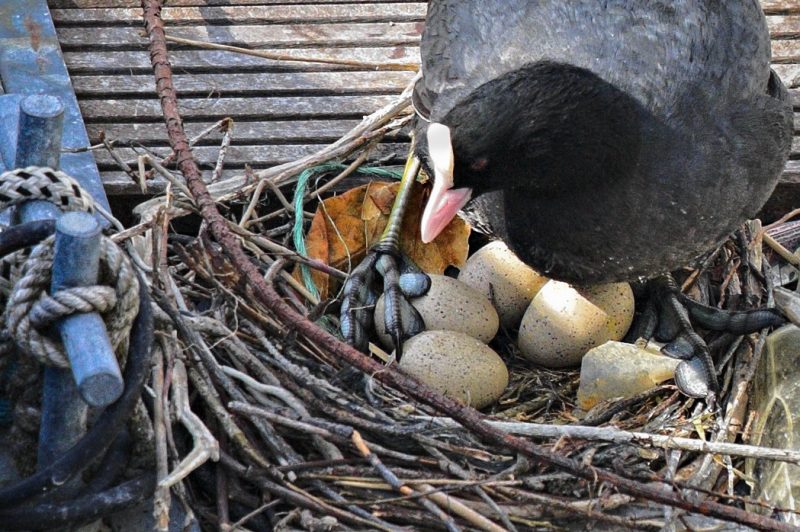
Oh, here is another mother bird forced to build her nest on a boat dock. It was on Lake Constance, Germany, as well. She’s a Coot, also a water bird – just look at her huge feet protecting the eggs 🙂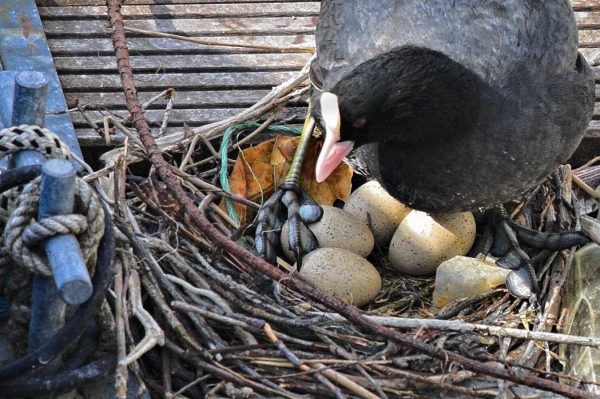
Here you can see how she tried to fight with a boater who had just landed on that dock 🙂 He was really puzzled and didn’t know what to do.

Canada
I can see the inconvenience of having the nest built on the ground level. I guess that birds nesting in trees face less dangerous situations. However, you never know who’s watching you…even if only with a camera 🙂 And there I was!
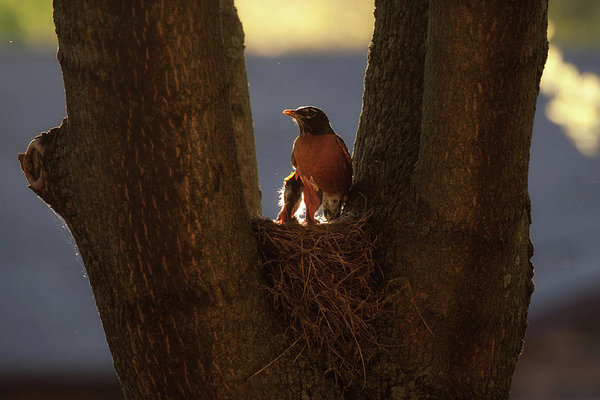
Yeah,… the dangerous situations are there but they differ .. This is a mother and her juvenile robin chicks who were just across from my balcony. (At that time we were living in a small town on Lake Erie, Ontario, Canada).
Look how hungry the little ones were:

I watched the mother robin hatching and feeding her youngsters, and the chicks taking their first flight 🙂
Life is beautiful!
- Most of these birds pictures are available as prints in various versions. Click on them for details.